
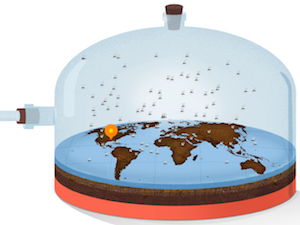
Geography is inescapable. Because, in all things, place matters. Take a whole lot of species, include humans, in a place and you will see what location has to do with disease. Here are a few examples.
Biomes
In your EVS classes, you will have likely studied what a biome is. What you have probably not studied are: (1) why are different biomes located where they are, and (2) how that location influences what goes on in that biome.
“A biome is a formation of plants and animals that have common characteristics due to similar climates and can be found over a range of continents. Biomes are distinct from habitats, because any biome can comprise a variety of habitats.” (Source)
Where each biome is located depends on many geographical factors: climate, soils, and topography. Climate, in turn, depends on latitudes, distance from sea or other bodies of water, altitude, slope, ocean currents, wind patterns, etc. Soils depend on the rock that has been eroded to form that soil type, how the rock was eroded, how the soil was transported, what other soils it is mixed with, etc. Topography depends on the specific types of Earth processes (tectonics, volcanism, etc.) at a location.
These variations lead to specific kinds of flora and fauna that live in a biome, and specifically in the habitats within each biome.
Places interact
One of the fundamental ideas in geography is that places interact. Nearer places interact more intensely than farther places. How to “places” interact? The Rajasthan desert does not say, “Hey, Amazon rain forest! What are you up to these days, bhai?” I know, that was a total PJ! But you get the point.
Interactions among places involve the movement of things from place to place. The “things” may include: people, ideas, genes, soils, moisture, winds, people, flora, fauna (yes, people are part of the fauna), and … pathogens!
Pathogens are any disease-producing agent, especially a virus, bacterium, or other microorganism (Source). They may spread within a species – e.g.: from humans to humans, monkeys to monkeys. Many times, pathogens jump from one species to another – e.g.: from non-humans to humans – a process called zoonosis (literally, “sickness from animals”).
Zoonotic (the adjectival form of zoonosis) spread of diseases are as old as life on Earth.
Zika, Ebola, malaria, schistosomiasis, “bird flu”, even HIV (the virus that causes AIDS) have come to humans from animals.
Why is this?
Well, humans are part of biomes and, within those, specific habitats. When we share our space closely with other species we are bound to interact. Some examples:
Humans consume certain kinds of meats in specific habitats, such as chimpanzee meat in parts of Africa. This led to the movement of the early HIV-like virus to be transferred from chimpanzees to humans.
Humans create local environmental conditions that promote the spread of some diseases. One of the biggest problems is lack of sanitation. Among other things, this leads to stagnant water. In tropical latitudes, stagnant water soon attracts different kinds of mosquitos. Depending on the location and the particular kind of mosquitos, different diseases spread when they bite infected animals (the “zoo” part of the zoonosis) and then bite humans. Hence the spread of malaria and zika, for example.
When people travel from places where the disease has entered them, they may end up spreading the pathogens to other people who come into contact with them. The distances they travel may vary – from local to regional to international. When disease spreads in a population, it is called an epidemic. When it spreads across national boundaries, it is called a pandemic. Remember, national boundaries are human creations; nature does not recognize these boundaries!
This is one way that places interact. And diseases spread.
Combating diseases
In an earlier column, I had talked about how asking geography questions can help doctors in treating a simple health problem like tummy trouble. When trying to combat diseases that spread, medical science has to understand the geography of the disease very well. If not, the spread of the disease cannot be fought.
Thus when Ebola became an epidemic and then a pandemic in Africa, and then spread to Europe and North America, first question to ask was where did this originate? Then, how did it spread from there to elsewhere? Here, geography meets medical and genetic science. Notice: this is the first of those geography questions I have talked about earlier (“Where is something?”). Then they ask why is that virus there in humans (the second question “Why is it there?”)?
Then the question is what is the consequence of the virus being there (this the third question). And then, finally how do we fight the spread of the disease? The methods depend on that final geography question I shared with you earlier – “What if?”
Mind you, it is not only zoonotic diseases that require understanding the geography of diseases. Even diseases such as cancer have a strong geographic component to them – certain places in the world are more prone to cancers than others. So, it is of immense help to know where the patient lives (or lived); it can help us understand what may have contributed to this person’s cancer.
Follow up:
- Not only can we understand where diseases came from, we can also monitor potential future places where diseases may flare up. Here is an interesting article with maps discussing exactly that. Read it to understand the geography of disease as well as how maps are used to communicate information.
- Here is an interactive page where you can assess your risk of contracting Zika – the virus that has been in the news a lot, lately. Think about the assessment you get from this page: is it fair or unfair? And why?
- This article reports that scientists were able to trace the Ebola outbreak of 2014-15 to a tree where children play, in Africa. What are the geography questions raised in this article? Are any of them answered?
- Humans have been modifying the environment in very big ways. Read this article about the environmental factors aiding the spread of Zika.
An earlier version of this article appeared in the Deccan Herald Student Edition, 07 July 2016
Featured image courtesy, WashingtonPost.com
Join us for the International Geography Youth Summit – 2016
(links to details are on the left)
#IGYS2016
#GeogInTheAnthropocene
@IGYS2016
No responses yet